
03 May 2026
By Shihab Ahmed, Journalist
The question posed in the headline is both difficult and, in some respects, painfully simple.
Let us begin from the beginning. Few would deny that a peaceful future and security for journalists are among the most essential prerequisites for a truly free press.
Put more plainly, the very theme of this year’s World Press Freedom Day reflects that reality. This year’s theme — “Building a peaceful future: Promoting press freedom for human rights, development and security”. alongside broader discussions on building peaceful societies through media freedom — ultimately brings us back to the same fundamental issue: without press freedom, there can be no meaningful guarantee of human rights, development, or security.
Today is World Press Freedom Day. The spirit surrounding this observance makes one thing increasingly clear: the conversation is no longer confined to journalists alone. It now extends to human rights, development, democratic stability, and public security as a whole.
In other words, ensuring freedom of the press is essential not only for journalism itself, but also for safeguarding the rights of citizens, ensuring accountability, and strengthening democratic institutions. Yet an unavoidable question remains: have journalists themselves secured a peaceful future or even basic security? Or do they still remain dependent on the goodwill of those in power? What does the reality tell us?
The answer, unfortunately, is simple: no.
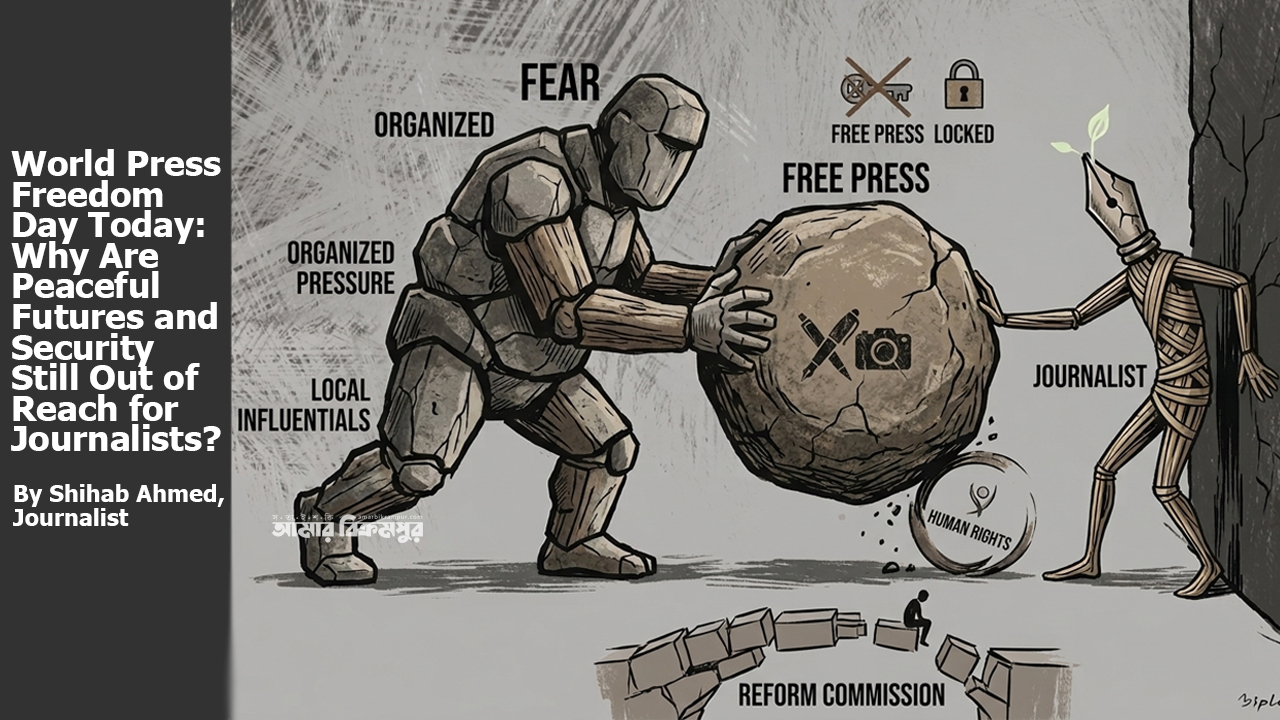
Even after the student-led mass uprising of 2024, the working environment for journalists in Bangladesh cannot honestly be described as fear-free. A culture of intimidation still exists. And if journalists themselves have become somewhat accustomed to compromise, the media institutions they work for have become even more deeply conditioned by fear and submission.
The attacks, arson, vandalism and looting carried out against two of the country’s leading media houses stand as undeniable evidence of this reality.
We surrender not because we wish to, but because those on whom we are locally dependent — those from whom we expect security, institutional protection, or even minimal reassurance — continue to lean toward the centres of power. This tendency is shaped less by professional ethics than by political and social realities.
“Collective intimidation” and the practice of “branding individuals with fixed political identities” have now become socially normalised.
Under the authoritarian government that was ultimately forced to step down in the face of a mass uprising, the Digital Security Act became one of the most feared instruments used against journalists. It was easily weaponised by ruling party actors and state institutions alike.
Today, although the law itself may no longer dominate headlines in the same way, another form of threat has become increasingly accessible to partisan groups and politically motivated actors: physical and psychological attacks.
This is why the discussion around journalists’ insecurity remains as relevant as ever.
Journalists in Bangladesh still find themselves waiting for sympathy, tolerance, or acceptance from whoever happens to occupy the centre of power.
There was, for a brief moment, a sense of hope when the reform-oriented interim government formed a Media Reform Commission following the political transition. The commission presented a number of ambitious recommendations aimed at improving the working environment of journalists and media institutions.
Among the most widely discussed proposals was an ordinance intended to ensure “protection of journalists’ rights.”
The initiative — which sought to guarantee professional independence, safety, and confidentiality for journalists — was widely welcomed within the media community and generated significant public interest.
Yet the interim government ultimately became a source of disappointment itself. None of the commission’s recommendations were implemented. More troublingly, no meaningful explanation was ever offered as to why those proposals were abandoned or ignored.
Mainstream media outlets themselves, quite consciously in many cases, also avoided sustained discussion on the issue.
The level of debate and advocacy that should have emerged from media institutions in defence of media workers simply never materialised.
Now, with a newly elected government formed by experienced lawmakers, there remains public curiosity about whether the issue will receive serious political attention. So far, however, little meaningful discussion has been visible.
As a result, legal harassment of journalists continues. Cases filed against media workers over published reports have not stopped. Journalists still find themselves summoned by security agencies or dragged into courtrooms for carrying out their professional responsibilities.
The spirit of journalism continues to collapse under the weight of fear.
And under that same fear collapses the possibility of a peaceful future.
Meanwhile, public reactions themselves have undergone a significant psychological transformation.
When Prothom Alo’s Savar correspondent Shamsuzzaman was jailed under the Digital Security Act during the rule of the now-deposed Awami League government, protests and solidarity emerged across the country. Journalists, civil society actors, and citizens spoke out loudly.
Yet after attacks were carried out against Prothom Alo and The Daily Star, the nationwide outrage was noticeably absent.
Did the journalists who protested before disappear from the country?
No. What disappeared was the courage to speak.
Why?
Because fear has deepened.
Fear of organised intimidation. Fear of being politically labelled. Fear of becoming socially isolated. Fear of being marked as belonging to a “particular camp.”
And that fear today appears far more intense than before.
In district and sub-district journalism — the reality of Bangladesh’s local press — these are not abstract concerns. They are visible, daily realities.
A local journalist often finds themselves isolated in the face of influential groups, political patronage networks, or administrative non-cooperation.
Many work without formal appointment letters, under severe salary disparities, and with constant job insecurity. Economic vulnerability further weakens their ability to resist pressure.
At the same time, internal divisions within the media community and the growing tendency to judge attacks on journalists through partisan political lenses have become serious obstacles to professional solidarity and collective resistance.
Ultimately, if journalists are forced to live in fear every day, democracy itself eventually learns to survive through fear.
Although international organisations continue to express growing concern over journalist safety and media freedom worldwide, the practical reflection of those discussions in Bangladesh remains painfully limited.